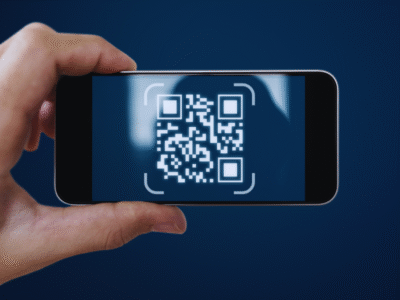
You’ve probably spotted a square, pixelated barcode on a lamppost, flyer, or tucked into the corner of a business card.
That little black-and-white box is called a QR code, short for Quick Response. These codes are everywhere today: scan one to download an app, open a restaurant menu, access a Wi-Fi network, or take advantage of a special offer on a website or social media ad.
While QR codes were invented in the 1990s, they only surged into mainstream use with the rise of smartphones. Mobile devices gave these digital markers new life, offering a quick, contactless way to connect people to information – instantly.
What Is a QR Code?
The QR code was invented in 1994 by Masahiro Hara, chief engineer at Japanese company Denso Wave, a subsidiary of Toyota. Originally designed for tracking automotive parts through factory production lines, QR codes were built to store more information than standard barcodes and to be scanned faster.
Unlike traditional barcodes that are read vertically, QR codes are two-dimensional – they can be scanned both horizontally and vertically. This allows them to store a much larger amount of data: up to 7,000 digits or approximately 4,000 characters, including letters, numbers, punctuation, and even web links.
Each code is made up of a grid of black modules on a white background. The specific layout changes depending on the type and amount of data stored, which makes each QR code unique.
Why Are QR Codes So Popular Now?
The QR code lay relatively dormant for over a decade, until the smartphone era made scanning easy and accessible. With built-in cameras and scanning software, people no longer needed a special device to read them.
Their touch-free convenience became especially valuable during the COVID-19 pandemic, when physical contact needed to be minimised. From then on, QR codes became a simple, efficient tool for businesses and individuals alike to connect, share, and engage.
Whether you’re browsing a product display, attending an event, or ordering lunch, QR codes are now a familiar part of everyday life – linking the physical world to the digital with just one scan.
